


most read
Software Engineering
Why We Killed Our End-to-End Test Suite Sep 24
Culture & Values
The Spark Of Our Foundation: a letter from our founders Dec 9
Software Engineering
The value of canonicity Oct 30
Careers
We bring together great minds from diverse backgrounds who enable discussion and debate and enhance problem-solving.
Learn more about our careers


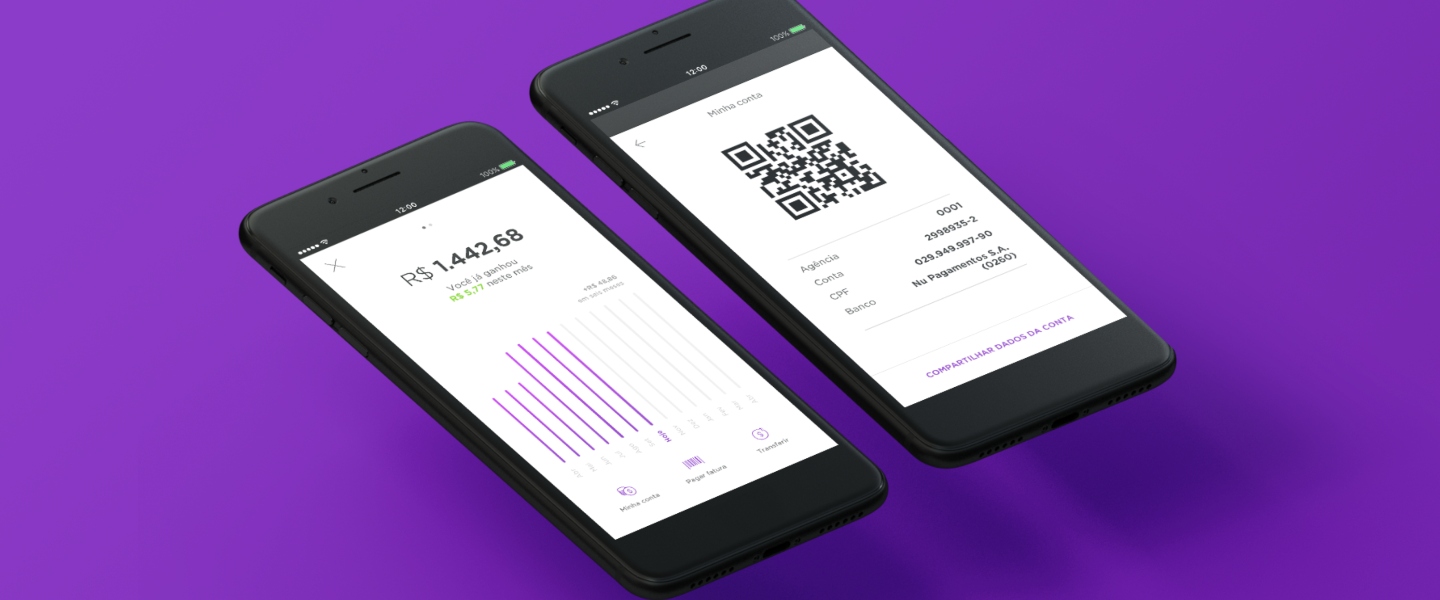
In October 2017, Nubank announced our boldest product release since our revolutionary credit card: NuConta, a single digital account that allows people to save, invest and transfer money in real-time. NuConta is a complete redefinition of how banking accounts should work, and here’s how our design team arrived at this new concept.
Start with why
Nubank’s core mission is to remove complexity and empower people. The credit card, our first product, has achieved viral growth among our customers by doing exactly this, but it’s a product accessible only to a select population due to credit analysis requirements. In fact, we have received over 13 million requests to get a Nubank card, but had to say no to a considerable percentage of those people. Our customer base, which is nearing 3 million accounts, is already representative — we’re currently Brazil’s no.5 credit card issuer — but still limited when compared to a market of 120 million Brazilians who are unbanked or have to deal with expensive and abusive banking services that dominate the market.
The next logical step in bringing our mission and user experience to a broader population, regardless of their income, credit scores or other barriers, was to build a product anyone could have access to: our version of a banking account, NuConta.
The team
Designing, building and launching NuConta in 12 months was only possible because of how the team was structured and governed. The squad, as we call teams here, was composed from the very beginning of product, financial, engineering and design talent, none of whom had built something like this before. It was a group of unbelievably bright, but most of all humble people, who were completely open to learning and having their opinions challenged.
This was, of course, a fascinating and unique project to be working on, so people couldn’t avoid coming in with their premature views and expectations for what the final product should be. The role of design was as much about facilitating alignment between these expectations, bringing clarity to compromises and decisions, and replacing our biased opinions with real people’s pains and needs, as it was about designing UI flows, copy, or making prototypes.
Design in an Agile Team
As much as we designers like to structure and visualize our process, what happens in our reality is more complex and asynchronous than the diagrams we’ve grown accustomed to.
Doing solid foundational research before starting anything else can surely de-risk product placement, but inevitably delays engineering and thus time-to-MVP.
What we did then, was to work in parallel threads:
Each of these threads constantly fed each other with their learnings and advancements, and we adjusted the product accordingly up to the last moment before shipping.
Check our job opportunities
Foundational research
We were committed to challenging our most basic assumptions about how people understand and use banking services, so our initial conversations were purposefully broad and naïve. We started with a simple list of questions, but we adjusted frequently along the way.
The fastest way for us to start asking (and testing) these questions was to sneak them into studies already being conducted by other product teams (namely, Credit Card and Nubank Rewards). We learned a lot very quickly by “stealing” a few minutes of our colleagues’ interviewing time, but their target audience could be skewed to non-target segments.
To balance that out, we got out of the building to do intercept interviews in places like public universities and spaces, where we could reach a wider variety of people who were not already Nubank customers.
These in-depth early interviews took 40–90 minutes each. We sat down and very informally let people talk about their financial lives, how they felt about saving, investing, transferring, and spending their money. We also experimented with some visual aids such as card-sorting and very cheap prototypes, but honestly our best feedback tools were our competitor’s websites and products.
Personas
By combining the data from these interviews with others conducted in our lab, and also talking to a lot of our own employees about their finances, we were able to come up with eight personas that represent a gradient of behavior and demographic patterns.
Personas can yield mix results, but we’re confident they were essential in this case. Here’s some of the value personas brought to our process:
Problem definition
With well-defined personas, we now had a lens through which we could look at the problem. Our initial mission, which was very broad, could now be better expressed in sentences that the whole team could agree on:
What NuConta is / does
NuConta is an evolution of your current and savings accounts, designed for people looking for a more accessible and easy-to-use bank account. It’s free of complexity, doesn’t charge abusive fees, and makes your money grow at a fair interest rate. Differently from big banks and other fintech pre-paid products, NuConta has zero bureaucracy, less friction to adopt and a superior user experience.
Likewise, defining what NuConta was not supposed to do, at least for launch, was equally helpful in creating vision alignment and prioritization:
What NuConta is not / doesn’t
NuConta doesn’t serve people looking for advanced investments, home brokerage, paid wealth management advice. It tries to be accessible and self-explanatory, but without becoming an educational product. At its early stage, it also will not support goals or any other kind of gaming mechanics.
After dozens of long work days, heated meetings, lots of head-scratching, word-smithing, and sense-making about the material collected during research, the team was finally committed to a unified vision of the product that reflected our customer’s pains and needs instead of our own.
We were now ready to deep dive into exploring solutions that would eventually become NuConta.
(Click here to read Part II of this post and learn about how the next steps played out: product ideation, UI explorations, concept & usability testing, onboarding design, copywriting, and implementation.)
Thanks to Vitor Olivier, Camille Ramos, Hugh Strange, and Lucas Neumann.
Check our job opportunities