


most read
Software Engineering
Why We Killed Our End-to-End Test Suite Sep 24
Product
Product Managers: what they do and why we need them Feb 15
Software Engineering
The value of canonicity Oct 30
Careers
We bring together great minds from diverse backgrounds who enable discussion and debate and enhance problem-solving.
Learn more about our careers


If you’re curious about the future of artificial intelligence and how intelligent agents are transforming industries, check out Nubank’s 95th DS&ML Meetup, with AI expert Sandeco Macedo. Discover how intelligent agents, large language models, and conversational interfaces are shaping the future and providing exciting opportunities for innovation and productivity.
Sandeco holds a PhD from the Federal University of Goiás and serves as a professor at both the Federal Institute of Education, Science and Technology of Goiás and the Federal University of Goiás. With six books on AI to his credit and a widely-followed YouTube channel, Sandeco provided an engaging and insightful exploration of Intelligent Agents, illuminating their significance in the current moment of technology.
Intelligent agents overview
Intelligent agents are systems designed to perceive their environment, make decisions based on those perceptions, and execute actions to achieve specific goals. Think of these agents as autonomous entities—like virtual assistants or automated processes—that operate independently, guided by rules, objectives, or learning mechanisms.
Sandeco clarified that intelligent agents range from simple reactive systems, such as automatic lights triggered by motion sensors, to complex learning-based agents utilizing advanced machine learning (ML) and deep learning (DL) algorithms. While reactive agents simply respond to inputs without memory, more advanced agents, such as those employing ML and DL, analyze historical data, detect patterns, and adjust their actions dynamically.
For instance, recommendation systems used by Netflix or Amazon are sophisticated intelligent agents capable of personalizing user experiences based on past behavior and preferences.
Check our job opportunities
Historical context: Alan Turing and the Turing test
To deeply understand intelligent agents, we revisited a fundamental question posed by Alan Turing in 1950: “Can machines think?” Turing introduced the “Turing Test,” designed to determine if a machine can exhibit behavior indistinguishable from a human. The test involves a human evaluator interacting with both a human and a machine through text-based communication, without knowing which is which.
If the evaluator fails to reliably identify the machine, it is considered to have demonstrated intelligence. Central to Turing’s idea is imitation—the core principle underlying AI. Intelligent agents do not possess inherent intelligence but rather mimic human behavior. Sandeco highlighted that this imitation includes replicating both beneficial and harmful human behaviors, emphasizing the essential role of ethical guidance and human oversight in AI development.
How Large Language Models (LLMs) work
A significant focus of the session involved exploring Large Language Models (LLMs), foundational to contemporary AI technologies like ChatGPT, Claude, Gemini, DeepSeek, and Grok. These models are built on a groundbreaking architecture known as “transformers,” which handle sequential data exceptionally well—making them highly effective in language processing tasks.
Sandeco explained the concept of tokenization, where text inputs are broken down into smaller units called tokens (words or subwords). LLMs then predict and generate the next token based on patterns learned during training. For instance, given the phrase “The capital of Brazil is…”, a transformer-based model predicts the next likely token as “Brasília.”
By repeatedly performing this token-prediction task, LLMs can generate coherent and contextually relevant text, mimicking natural human language fluently and convincingly.
Introduction to Crew AI
One of the most exciting discussions revolved around Crew AI, a library developed by a Brazilian startup valued at approximately R$300 million and recognized by leading tech companies such as Nvidia. Backed by influential figures like Andrew Ng, Crew AI facilitates the creation of intelligent agents organized in hierarchical, collaborative teams—similar to human organizational structures.
This library enables complex workflows to be automated, such as managing extensive business processes or orchestrating collaborative tasks across multiple agents. Crew AI represents a significant step forward, allowing intelligent agents to interact, delegate tasks, and efficiently solve intricate problems through teamwork.
Practical demonstration of Intelligent Agents
The meetup featured a compelling practical demonstration showcasing intelligent agents automating social media tasks. Sandeco demonstrated how an agent could autonomously process and enhance an image, generate an accurate and contextually rich description, and compose a humorous, engaging social media caption.
This workflow, managed by interconnected intelligent agents, culminated in the fully automated posting of the content to Instagram, exemplifying a seamless Text-to-Action pipeline. This practical illustration highlighted the potential of intelligent agents to significantly reduce human intervention, allowing individuals and organizations to focus on higher-level strategic thinking and creativity.
Conversational interfaces and automation
Sandeco elaborated extensively on conversational interfaces, highlighting their growing importance and potential to replace traditional graphical user interfaces (GUIs).
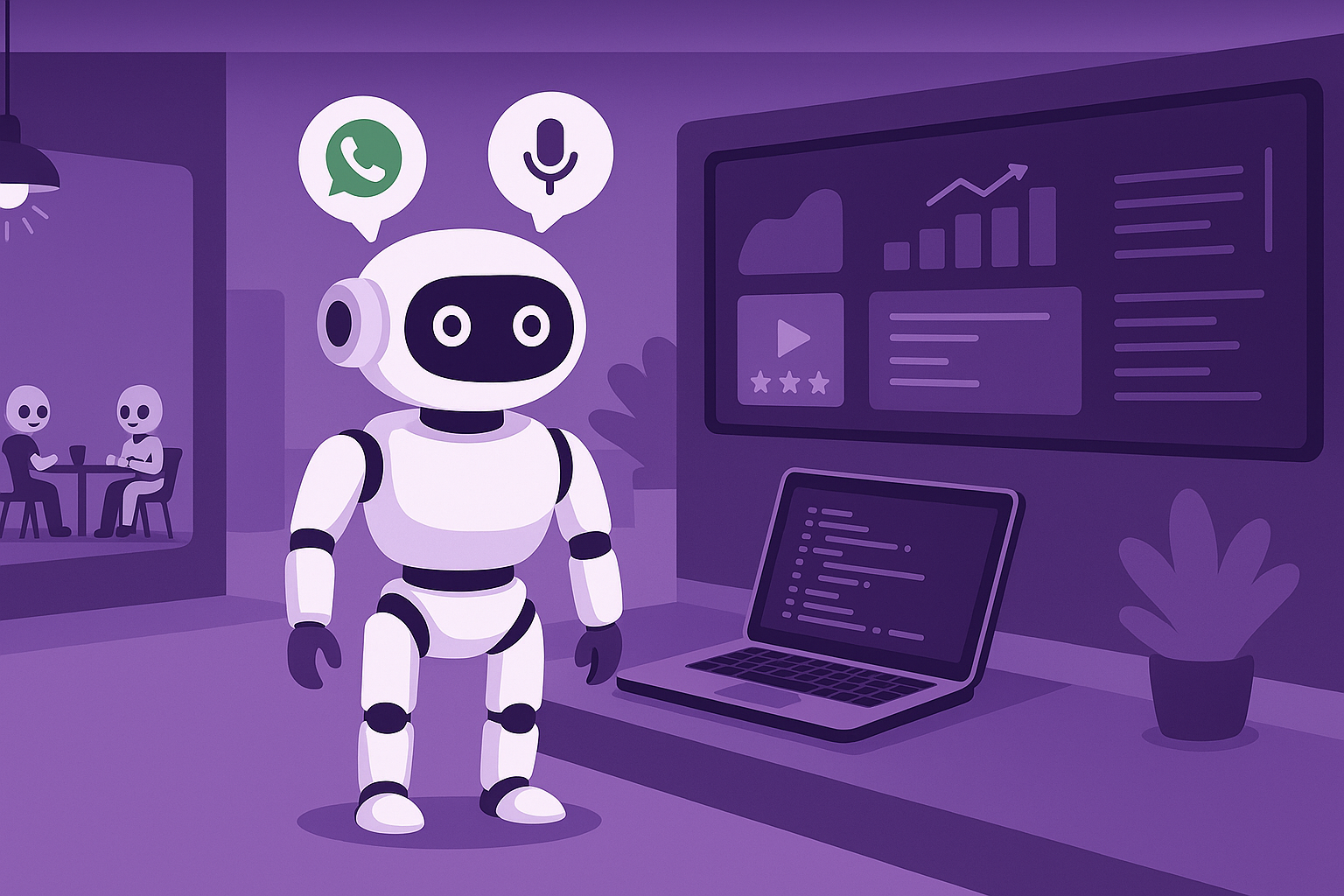
Conversational interfaces, including voice and text-based interactions, enable users to communicate naturally with technology, drastically simplifying user experiences. In a captivating live demonstration, Sandeco queried an intelligent agent via WhatsApp, requesting detailed information such as identifying the top-selling products and vendors from a CSV sales dataset.
Impressively, the agent dynamically wrote Python code to process the query, accessed the relevant data, and responded with synthesized speech, delivering actionable insights immediately. This powerful example underscored conversational interfaces’ transformative impact on accessibility, efficiency, and user engagement.
Future implications and recommendations
Concluding the session, Sandeco addressed the future role of developers in an AI-enhanced world, highlighting a shift towards “pair programming,” where AI systems collaborate directly with developers. Far from replacing humans, these AI assistants augment human capabilities by managing repetitive, mundane tasks, thereby allowing developers to focus more deeply on innovation and strategic problem-solving.
Sandeco strongly advocated viewing AI not as a threat but as a powerful opportunity for professional growth, skill enhancement, and increased productivity. He encouraged attendees to proactively assess their current roles, identify repetitive tasks, and explore potential automations to future-proof their skill sets and thrive in the rapidly evolving technological landscape.
As artificial intelligence continues to evolve rapidly, understanding intelligent agents and their applications becomes essential. At Nubank, we are committed to innovation and empowering our community with the knowledge and tools needed to leverage AI’s transformative power. Join us as we study the future of technology together and build the purple future.
Check our job opportunities