


most read
Software Engineering
Why We Killed Our End-to-End Test Suite Sep 24
Product
Product Managers: what they do and why we need them Feb 15
Software Engineering
The value of canonicity Oct 30
Careers
We are building diverse teams with the most creative and innovative professionals for each position we open.


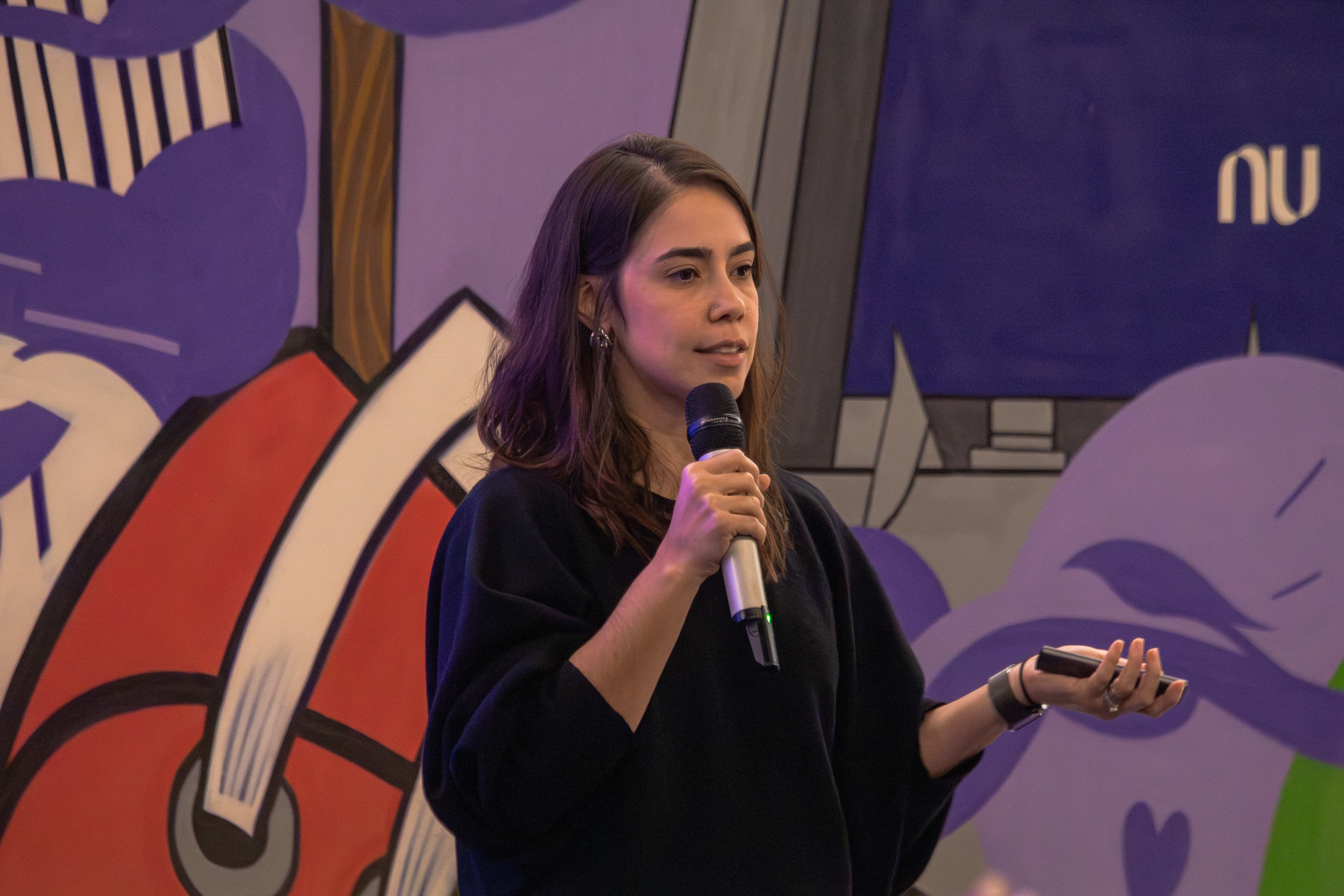
In late October, Bruna Costa, Product Director at Nubank, presented NuCel, the company’s virtual mobile operator (MVNO) at Esquenta Product Camp event. The presentation, hosted by PM3 at Nubank’s Pinheiros office, detailed a product journey rooted not just in telecom specifics, but in Nubank’s foundational product principles.
To understand the context of NuCel, one must return to the initial principles that defined product development at the company.
From the start of Nu to the start of NuCel
Tracing the company’s trajectory, the presentation highlighted the core principle underpinning every product decision: customer culture. The founders’ 2012 thesis, that technology companies could leverage competitive advantages to transform dysfunctional markets, initially targeted the highly frictional Brazilian financial sector. The mission to fight complexity and empower people was born from this context.
As the ecosystem matured, the guiding question evolved: how to apply that mission to other experiences central to daily life. This context positions NuCel not as an opportunistic market diversification, but as a strategic, logical extension of Nubank’s vision, tackling a mobile service market historically defined by complexity, confusing contracts, and a constant consumer need to “decode traps” just to use an essential service.
Check our job opportunies
The pain points that revealed the opportunity
When the team mapped the telecom industry in depth, they noticed something revealing: the main pain points reported by people were not related to network quality or transmission technology, but primarily to the overall user experience. This included difficult cancellation, broken number portability, barely helpful support, slow or confusing apps, plans surrounded by asterisks, and a complete lack of transparency.
Recognizing that this was exactly the kind of complexity Nubank was created to solve, the company made the strategic decision to enter the telecom market. Their core goal was not to compete on infrastructure, but rather to transform people’s relationship with a service that had always been unnecessarily bureaucratic.
To ensure the product addressed these core issues from the ground up, the team defined its essential pillars: Transparency was non-negotiable; the activation journey needed to be fully digital; customer freedom had to be real; and simplicity had to guide every decision, from plan selection to how usage is adjusted throughout the month.
The NuCel platform incorporates features adapted from the core Nubank experience, designed to eliminate friction. These include smart usage suggestions that predict data consumption and an accrued data reserve (inspired by the successful “Caixinhas” savings feature) that is automatically applied when needed. Crucially, integration with the financial ecosystem is achieved via the Caixinha Turbo, which yields 120% of the CDI rate for NuCel customers—a unique market model connecting telecom value with financial yield.
The Product Director acknowledged that none of this simplifies the regulatory hurdles. She shared backstage details on essential processes like number portability, highlighting challenging negotiations and granular technical details. These adjustments, invisible to the user, are an essential part of developing an industry that is new to the company.
Iteration, errors, and constant learning
Bruna approached product missteps and continuous evolution with candor. NuCel’s development followed a clear path of iteration and adjustment. The data reserve, for example, operated as a backend Minimum Viable Product (MVP) for months—invisible to the user—before its visual integration into the app. Similarly, the activation and portability flows required intense effort and countless iterations to achieve a fluid user experience.
The team’s focus was on balancing the minimum required for market competition with the features designed to drive customer delight, a key product principle. This dynamic is inevitable when building into an existing market, requiring navigation between regulatory urgencies, technical requirements, operational commitments, and the desire for differentiation from day one.
How to prioritize in Nubank’s app that is always growing
A critical discussion point was the navigation prioritization within Nu’s app context: NuCel operates with its own autonomous team to manage the backlog, roadmap, and priorities, but it is also part of a much larger ecosystem. The Product Director shared the strategic rationale behind the in-app positioning.
Following extensive analysis of user flows, mental models, navigation patterns, user tests, and architecture options, the decision was clear: telecom required a new, dedicated vertical, rather than being categorized into existing sections. This led to the creation of a dedicated tab, internally designated as a premium space reflecting the product’s high strategic importance. While this structure represents the best configuration for today’s stage of Nu’s ecosystem, both the app and our navigation model evolve continuously. As Nu grows and new product needs emerge, the app’s architecture will keep adapting to ensure coherence, simplicity, and customer-centricity across experiences.
Entering a consolidated market responsibly
Bruna was straightforward in addressing the scenario of entering the highly consolidated and complex telecom market. Nubank enters with huge expectations but maintains a realistic and humble approach, as entering a new sector required a responsible rollout strategy guided by a clear set of guardrails.
The most critical metric for the company is Net Promoter Score (NPS). The company uses NPS as the permanent reference point, particularly during the first year of any new product. The decision to advance rollout, expand to new customer groups, or scale campaigns is directly contingent on a healthy NPS. This criterion is explicitly prioritized over volume goals or aggressive growth targets, ensuring the product maintains its commitment to customer delight.
Product culture or customer culture?
When questioned about whether a product culture encourages exploring new industries, Bruna offered a crucial correction: Nubank operates under a customer culture. This singular principle guides all activities, from initial discovery research and strategic C-level discussions down to tactical UX decisions.
The team also uses the internal 3D framework (Discover, Deliver, Delight) to guide product construction, emphasizing that it is not a rigid recipe. It is a flexible starting point, complemented by continuous cross-team collaboration, collective learning, and the autonomy to adapt tools to context.
In recent months, NuCel has surpassed team growth projections, maintaining an NPS above the industry average and validating the market demand for a better experience. The first marketing campaign has already launched on the streets and on TV, and while official numbers are not yet disclosed, confidence in the path ahead is high.
Closing the talk, the Product Director confirmed the core vision: NuCel’s mission is to move beyond being a commodity mobile plan. By applying Nubank’s foundational logic of identifying pain points and reimagining simplicity, the company created a solution customers willingly choose, rather than one they are stuck with.
Check our job opportunies