


most read
Software Engineering
Why We Killed Our End-to-End Test Suite Sep 24
Product
Product Managers: what they do and why we need them Feb 15
Software Engineering
The value of canonicity Oct 30
Careers
We bring together great minds from diverse backgrounds who enable discussion and debate and enhance problem-solving.
Learn more about our careers


When Edward Wible’s father heard that his son was planning to move to Brazil to start building a digital bank, he pulled the car over to the side of the road, paused, and confirmed whether he had heard correctly. Starting a bank “from scratch” sounded silly enough in Chicago – doing it in Portuguese, more than 5,000 miles south in São Paulo, Brazil, made it downright hard to believe.
Today, nine years later, Ed is the co-founder of one of the 100 most influential companies in the world, according to the latest list by Time magazine. Moreover, Nubank is one of the biggest digital banks worldwide, with nearly 60 million clients across Brazil, Mexico, and Colombia.
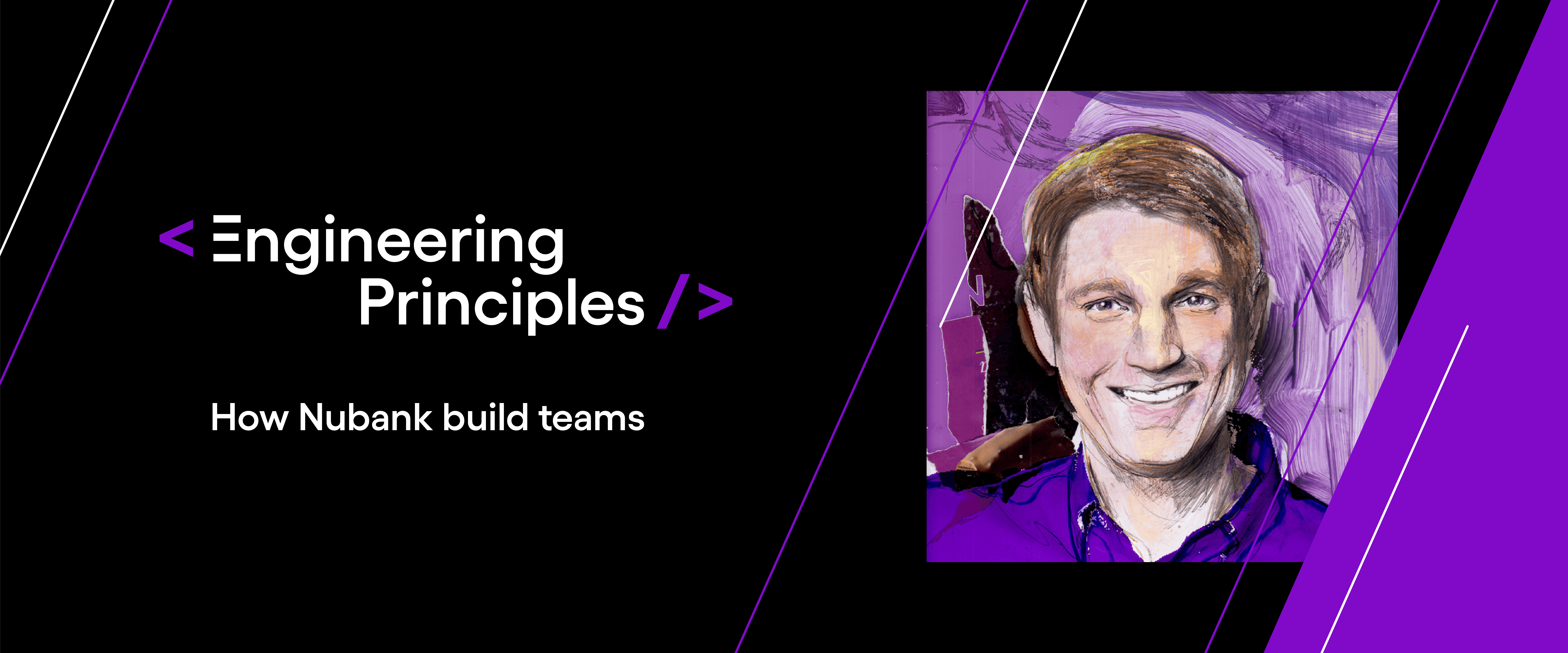
As Nubank’s first software engineer, Ed, now 39 years old, shaped the engineering culture from the early stages of this insurgent fintech. Currently, he keeps focusing on assisting tech teams in fighting against traditional financial bureaucracy by building cutting-edge technology.
Nubank’s Engineering Principles
In April 2022, Nubankers celebrated their Engineering Principles with a two-day event to discuss, reflect, and reinforce these in a rapidly scaling environment.
After nine years of Nubank, those principles have emerged from patterns of success and serve as a guide to assist the engineering process rather than particular prescriptions.
We think of these principles as aspirational or, in a sense, utopian. As Uruguayan writer Eduardo Galeano put it:
Statements of Engineering Principles – How We Operate
Statements of Engineering Principles – How We Build Teams
In this interview, Ed Wible talks about how Nubank turned from a startup in a Latin American country into a company that is reshaping the whole services industries around the world and one that, since last December, has been listed on the New York Stock Exchange (NYSE).
Check our job opportunities
An inspiration to do the best work of our lives
Question: How were Nubank’s engineering principles created?
Edward Wible: Nubank’s engineering principles are not where we started; they have sort of emerged from what we’ve learned, which we want to crystallize and memorialize as important. A team with more experience, collectively, in 2013, when we were born, might have known how to start with principles, but our humble team needed to learn them on the job.
I would contrast that with the values of the company, which are higher level and were very clear even very early in the company’s history. I think of the engineering principles as an extension to those values that are a little bit more specific in terms of driving alignment around how we build technology and what we build with it.
Q: So, the company is transitioning from an English Constitution kind of, an implicit law, to a written one. Which were the needs identified to have those Nubank’s engineering principles written now?
EW: As you start scaling, just to simplify, you can sort of go two ways. You can try to articulate the “why” as a principle behind “why we are this way” and then have people self-organize and align to that. Or you could try to set up a bunch of rules, gatekeepers, and reviewers, forming a bureaucracy that enforces your rules.
For the technology industry, full of bright, ambitious knowledge workers, for people as passionate as the ones we attract to Nubank, you don’t want to have a bunch of rules. You want to have some high-level principles that people can interpret and get on with things. Choose to have a few key principles and maintain your ability to move fast.
How Nubank operates
1. Leverage Platforms
Q: “Leverage platforms” seems very obvious, but it may not be obvious when dealing with a company such as Nubank. Why is it the first of Nubank’s engineering principles?
EW: The obvious thing for a startup like ourselves is to decentralize. So, what you want is a lot of tiny teams moving fast. You want every team to feel like a startup. But if you go too far in that direction, then you lose leverage.
And what it gives rise to is effectively a multi-tier system in the company. You’ve got frontline teams that are direct to the consumer, building products. But then you have tiers of teams below that, where you have folks building tools, platforms, and guidance for other folks inside the company. But all rivers run to the sea.
The other reason I don’t think this principle is obvious is that it’s almost always harder to design and execute a platform than to pick the fastest route to market. There needs to be a certain discipline around investing upfront, considering multiple possible futures, and then reaping the benefit of that investment via subsequent use cases for the platform or tool.
This sort of patience and discipline is far from the default in this business.
2. Customer trust is hard to earn and easy to lose
Q: Let’s move forward to the second of Nubank’s engineering principles. This concerns every single Nubanker; ‘Customer trust is hard to earn and easy to lose.’ How does that translate to the engineering way of working, differently from, let’s say, communicators like me?
EW: So, I’ll give you an analogy. Many startups continue to say: “move fast and break things.” The objective was lightly controlled chaos and speed above all else. I don’t think this is a sound strategic mindset for our reality as an institution.
While we are continuously expanding the breadth of what we offer, we continue to operate in a very specific industry. We occupy a sacred place in society, and we’re regulated by governments for exactly this reason. That makes us different from every other company in the world.
Perhaps it makes us similar to other critical infrastructure companies like banks and utilities, but honestly, I don’t think that these companies treat their customers with the sort of respect that we do.
While public utilities are very boring companies, I like the analogy. I don’t necessarily worry about whether people are always talking about us, as long as they wouldn’t want to live without us. One could say this quite easily about electricity, right?
3. Data as a strategic asset
Q: If we talk about Latin America, the pandemic also introduced or led, all of a sudden, a lot of new people to the digital world who now have to deal with digital tools. That leads us to the third of Nubank’s Engineering Principles, which is Data as a strategic asset. How has Nubank risen to that challenge differently from incumbents?
EW: It’s very common for banks to find their data fragmented into different silos. Every department is able to perceive a different part of the elephant, so to speak, and this manifests itself quite clearly as incoherence for customers.
When you can’t figure out how to quickly and reliably integrate relevant information about a customer’s context, you never get a single coherent view of that customer, because it’s all these fragments. So, every time you talk to a big bank, you get a different answer, the left hand doesn’t know what the right hand is doing, and so on.
On the contrary, at Nubank, we always strive for coherence. Even as a growing company, we should be capable of underwriting credit and defending against criminals better than anybody because that’s at the core of what we are built to do.
4. Ownership and technical resiliency
Q: Nubankers dare to discover things on their own, building things from scratch. On those trails, it is normal to make mistakes. That leads me to the fourth principle, which is Ownership & Technical Resiliency. Why are both ideas together?
EW: Ownership mentality for engineers means the system you build is like your baby. You’re going to put that thing into production, you’re going to run it. If it has a problem at night, you’re going to wake up. If you’ve got to do maintenance, you’re going to do the maintenance. If there’s a cost, you’re going to bear that cost.
And that is the only way to have a sustainable culture that is free from the worst conflicts that we tend to see in our industry. The average company has this division between Dev and Ops. So, there are people who build stuff, and then they throw that over a wall, and then there are people who run stuff and want things to be as stable as possible.
At Nubank, there’s no wall that you throw it over. It’s just you, beginning to end.
Q: We always have people in every single place of the company with a systemic view. Am I right?
EW: Right! And I think it comes from our identity from the beginning. Our only strategy was to be the best.
Given that we’re talking about Nubank’s Engineering Principles, you can see that everybody’s trying to do the best work of their lives. They’re not just trying to phone it in and get through the day doing this or that out of obligation. No, it’s like, we’re trying to do something excellent.
5. Canonical Approaches, Consistently Applied
Q: The following Nubank Engineering Principle is perhaps the most difficult for non-engineers to understand at first glance. What is a ‘Canonical approach’?
EW: Agreed, this may be one of the more technical terms. Striving for canonical approaches is another counterbalancing principle in the sense that we want a local ownership mentality, we want decentralization, we want people to go as fast as they can.
But if everybody’s doing their own thing in their own way locally, we lose the ability to evolve the system as a whole.
Adopting canonical approaches, which is basically a directional goal, it’s not adopting an explicit list of enumerated approaches, and it doesn’t mean one concrete thing. It means fewer, tighter, and more deliberate choices.
Nubank has fewer projects that are killed mid-stream, and more projects that are finished, by far, than any company I’ve seen in my career. The reason for that is we commit to finishing our migrations and view non-strategic (read: accidental) variance in our systems and approaches with skepticism.
How Nubank Build Teams
6. Multiple perspectives build better software
Q: Maybe frustration is one of the most leading sentiments that the world had during the pandemic and after. When I arrived in mid-2019, we were a dominant actor, but still kind of a startup that was growing. Now, there are thousands more Nubankers, Nubank acquired many companies – as Easynivest –, and is a public company trading on the NYSE. I’m sure that the two concepts composing the following Nubank Engineering Principle, “Multiple perspectives build better software,” were strictly different three years ago.
EW: Yes. But I’m not sure the aspiration is so different because in general, we’re talking about frontline teams. And also, in general, pretty much every team is about the same size. A group of 100 people is not a team. So, almost all the teams are sort of four to ten people.
We don’t want a team to have a wrong shape. And a team of the wrong shape is, for example, a team where everybody was just hired. Or a team where everybody is very new in their career.
If our ambition is as big as it is – to provide global financial services to everybody –, then you’ve got to have a slice of the world inside the company.
We want to have an inclusive environment, we believe that different people bring different ideas, and the best idea wins. So, if you’ve got more ideas to draw on, you make better choices. That’s not always true in our industry. Diversity and internationalism are two of our goals.
Q: It must have been difficult to find a balance between attracting diversity and keeping performing to be the best services company in the world. It sounds like you are not seeking to attract just a cultural elite.
EW: That was one of the things we struggled with sometimes, even with investors early in the company, who would ask us, “Show me the educational qualifications of all of your engineers”. We were focused on completely different characteristics of people other than credentials.
So, the way you drive alignment and execution, and the way you make these budget decisions and all those things that are sort of tree-like, that clearly changes and will continue changing as the organization scales. That is one of the reasons that I’m not the CTO of Nubank anymore. That became a very specialized skill, and my skill was something else.
Q: What type of engineer is Edward Wible? How would you define yourself?
EW: I think I’m a grinder. I like to just grind away, whack away, keep going, and never give up. Just like, keep at it.
Check our job opportunities